
Inside Attic Salt's Naming Process
The strategy, collaboration, and tough decisions behind a name worth owning.
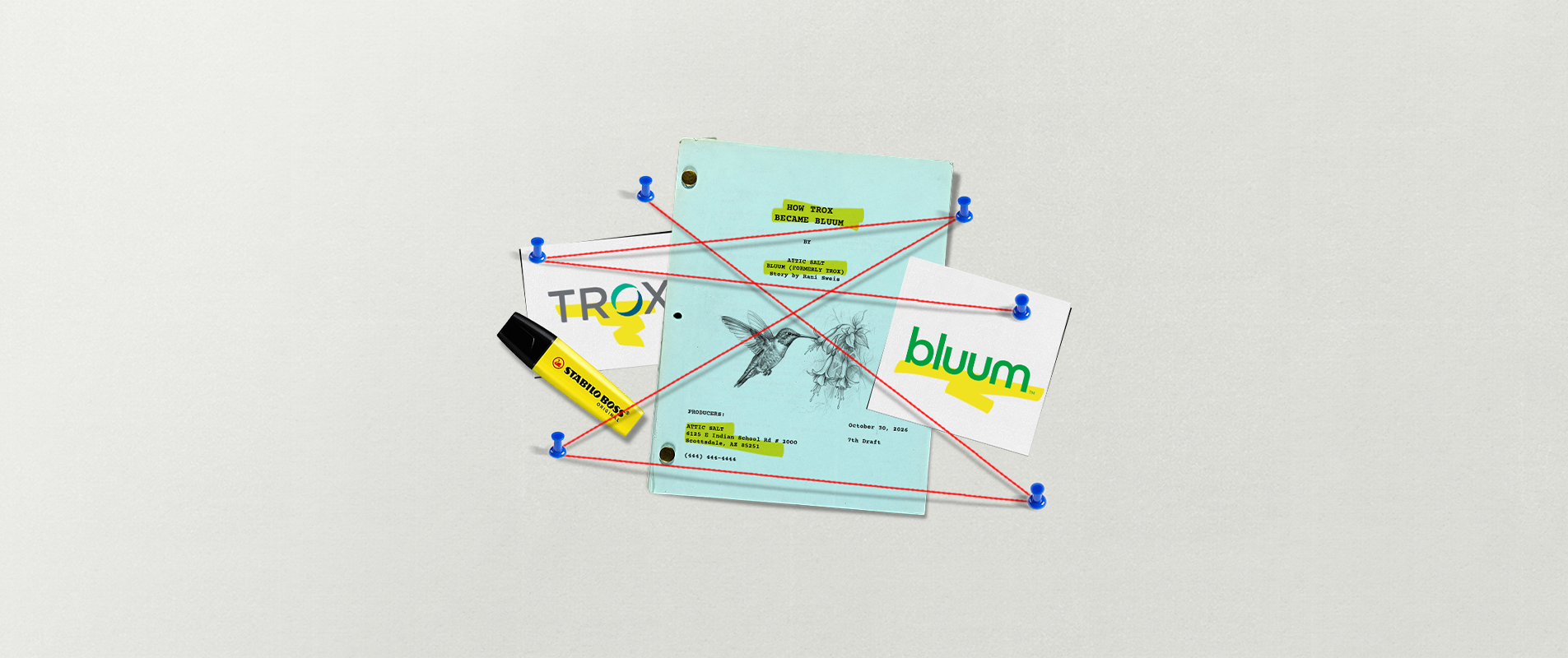
Before we spent a minute naming Bluum, we had to answer a more important question—Should the company change its name at all?
At the time, the business was called Trox, a K-12 technology solutions provider formed through a series of acquisitions, including Tierney, CDI, and various other smaller brands. The company had grown quickly, which introduced a whole new set of challenges.
Employees still identified with their former companies. Customers didn't necessarily understand how the businesses were connected. And Trox, a shortened version of the legacy name Troxell, did very little to unite the disparate cultures.
Another complication was that the CEO wasn't entirely convinced a company's name mattered enough to justify changing it. It's a fair question.
Renaming an established business isn't cheap, simple, or risk-free. It means having to reintroducing yourself to people who already know you. Sometimes the equity in an existing name makes that disruption a terrible idea.
So rather than starting with a brainstorm, we started with an investigation.
Making the case for change
A name can accumulate enormous value through years of customer experience, recognition, and trust. Replacing it without understanding that equity is like renovating a house before checking whether the foundation is sound.
For Trox, we examined what customers associated with the existing name, whether it carried meaningful equity, and whether a new identity could help unite the business. Research involving more than 400 customers and prospects revealed that over half found no meaning in the name Trox, while only 17% expressed positive sentiment toward it.
Meanwhile, leadership had ambitions well beyond selling A/V solutions to schools. They wanted to make exceptional education more engaging and accessible, empowering educators and improving learning outcomes. That purpose offered a far more compelling foundation for an identity than a shortened former owner's name.
We still evaluated both sides. Keeping Trox would preserve continuity and avoid the cost and complexity of introducing another name. Renaming would create an opportunity to unite employees, differentiate the business, and build an identity more closely aligned with its mission.
Ultimately, we believed the opportunity outweighed the risk. Not because Trox was a terrible name, but because it did little to help the company become what it aspired to be.
Finding the meaning before finding the name
With a clear strategic direction, we turned our attention to the competitive landscape. Companies such as CDW, SHI, Howard, and Prosys dominated a category characterized by fairly institutional, technical, and conventional naming. They communicated competence, but left considerable room for something warmer and more imaginative.
We weren't interested in creating another name that sounded like a technology reseller. We wanted one that captured the potential of education. Instead of asking what words describe hardware, software, or technology, we explored the possibility of excellent education: curiosity, discovery, growth, momentum, connection, and unlimited potential.
These became the foundation of our creative territories.
At Attic Salt, we use techniques like mind mapping, word association, metaphor exploration, linguistic research, and lateral thinking to uncover unexpected connections. A mind map is particularly useful because it encourages us to move beyond the most obvious associations.
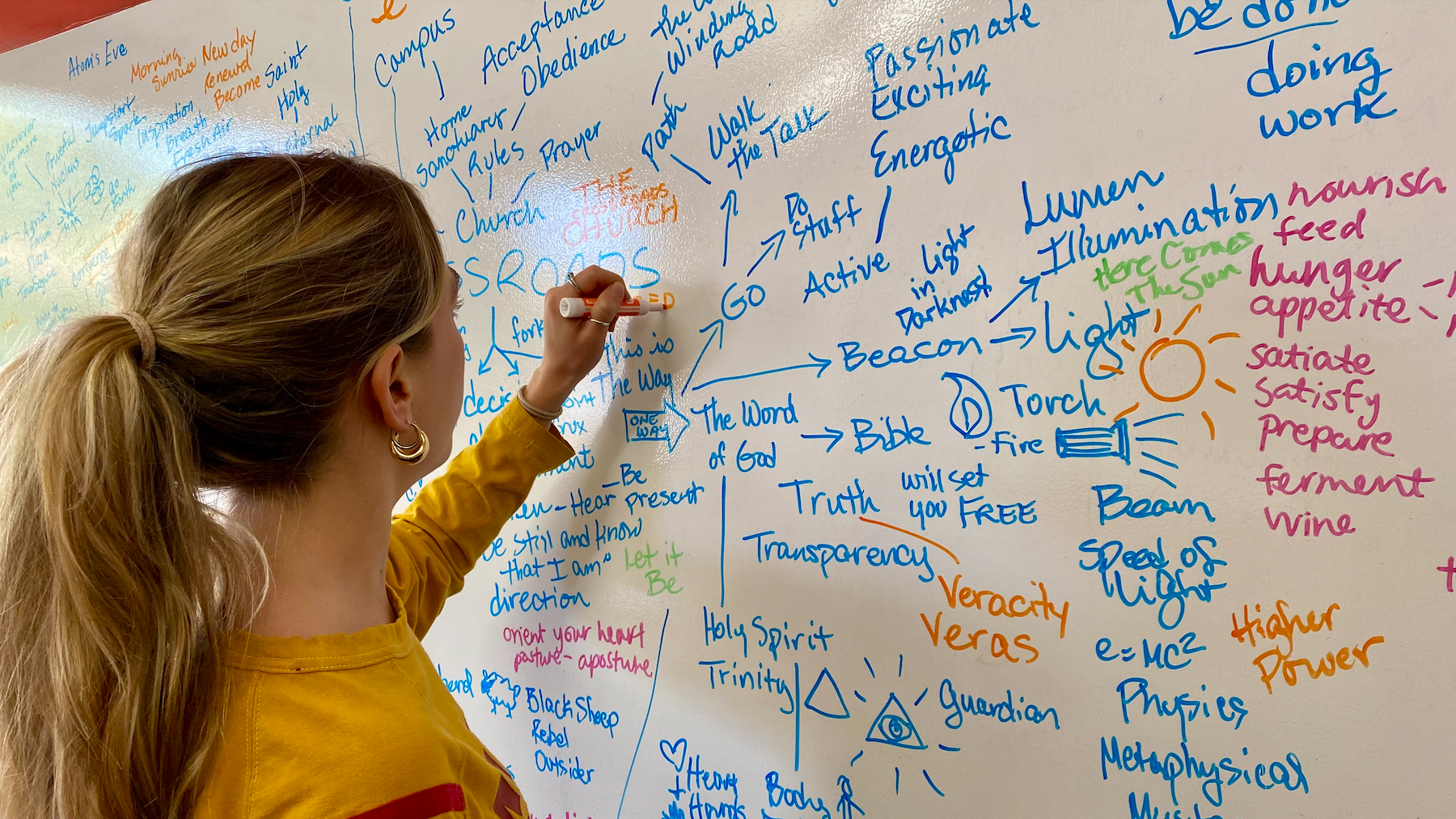
Consider the word "potential."
One path might lead to growth, nature, seeds, sprouts, and seasons. Another might lead to possibility, exploration, outer space, and the frontier. Neither has much to do with selling classroom technology. Both have everything to do with what education can enable.
Our exploration branched into themes such as Technology Meets Education, Space Travel, Knowledge Is Power, Better Together, and Unlimited Potential. Each offered a different lens through which to interpret the same brand strategy.
More minds. More ideas. Better possibilities.
Professional creativity is essential, but we don't believe a small agency team has exclusive access to every promising idea. Some of the most interesting insights come from employees who live and breathe the business every day.
For Trox, their participation served an even greater purpose. With employees joining from several previously independent companies, a new name presented an opportunity to create a shared identity. But announcing an unfamiliar name without involving anyone could just as easily reinforce the divisions we were trying to overcome.
So we organized a weeklong naming sprint, inviting selected employees from Trox and Tierney to contribute ideas.
Participants began with an anonymous survey about the existing brand and culture, followed by a naming guide explaining what makes a name strategically effective. Then, each day, they received a creative theme, research cues, and an invitation to submit one to three ideas.
The themes progressed from Technology Meets Education to Space Travel, Knowledge Is Power, Better Together, and Unlimited Potential. Rather than asking employees to dream up clever company names, we gave them different ways to explore the business's purpose.
The sprint generated more than 370 naming suggestions. Meanwhile, our creative team independently explored and evaluated more than 120 candidates, using the same strategic foundation.
That gave us a substantial pool of possibilities. But the organizational value was equally important. Employees from different legacy businesses had been invited to help shape the future of one company.
"Naming isn’t a democracy. But that doesn’t mean it needs to be behind closed doors."
Of course, participation doesn't mean putting the winning name to a popular vote. We evaluate every suggestion against the same strategic criteria, regardless of where it originated. Sometimes we even introduce a little friendly competition, rewarding employees whose ideas advance or are ultimately selected.
AI: Where the machines fit into our process today
The Bluum engagement took place in 2021, before generative AI became a mainstream creative tool. Today, we've added a third source of exploration.
Using the same strategic inputs and creative territories, AI helps us investigate additional metaphors, linguistic roots, cultural references, and naming constructions at a scale that would be impractical manually. It's especially useful when searching for distinctive names in an increasingly crowded trademark and domain landscape.
But generating hundreds of names is easy. Recognizing which ones are meaningful, memorable, and worth investing in is where the expertise comes in.
AI expands our possibilities. It doesn't replace the judgment required to identify a great name or the professional clearance needed to establish whether it can be used.
The art of elimination
With hundreds of possibilities on the table, the challenge shifts from creative exploration to disciplined evaluation.
Our process draws on the methodology developed by naming agency Igor, using structured naming taxonomies to objectively assess names beyond personal preference. The naming matrix considered ten dimensions:
- Brand alignment
- Humanity
- Depth
- Springiness
- Aesthetics
- Sound
- Timelessness
- Originality
- Stickiness
- Gettability
Some are self-explanatory. Others reveal what makes naming more nuanced than it appears.
Depth considers whether a name carries meaningful associations that support the brand story.
Springiness examines its creative potential beyond the word itself. Could it inspire visual ideas, messaging, campaigns, and experiences?
Stickiness considers memorability, while gettability addresses whether the name can realistically be secured and protected.
The matrix doesn't eliminate subjectivity, but it provides an objective framework for discussing trade-offs. A name might be exceptionally memorable but difficult to trademark. Another might be easily available but lack the personality or depth needed to support the positioning.
Without that discipline, naming decisions often deteriorate into a battle of personal associations. Somebody dislikes a name because it reminds them of an ex. Somebody else loves one because it sounds like their dog. Neither is a particularly compelling brand strategy.
We developed five principal naming directions for the client presentation:
- Trolley
- Parachute
- Plume
- Troop
- Bloom
We never present names without context and ask everyone which they like best. Each name comes with its own narrative, strategic rationale, potential taglines, domain considerations, and opportunities for creative expression.
Trolley suggested a journey toward better education, creating opportunities to explore destinations and conductors, and to move forward together. Parachute expressed the support educators need to reach new heights, with an additional connection to the colorful parachute games familiar from elementary school. Plume connected rocket propulsion with the feather once used as a writing instrument, uniting progress and learning in a single metaphor. Troop emphasized collective strength and the idea that improving education takes a community.
And then there was Bloom.
The name expressed the remarkable potential within every student. Growth, nurturing, and flourishing were natural associations, but it also carried a deeper connection to Bloom's Taxonomy, a familiar educational framework describing levels of learning and cognitive development.
It was optimistic, human, immediately relevant to the audience, and rich with creative possibilities. We could imagine entire messaging and visual systems built around helping students flourish.
That's what we look for when evaluating names in context. A strong name shouldn't just sound interesting. It should give the brand somewhere meaningful to go.
A name worth fighting for
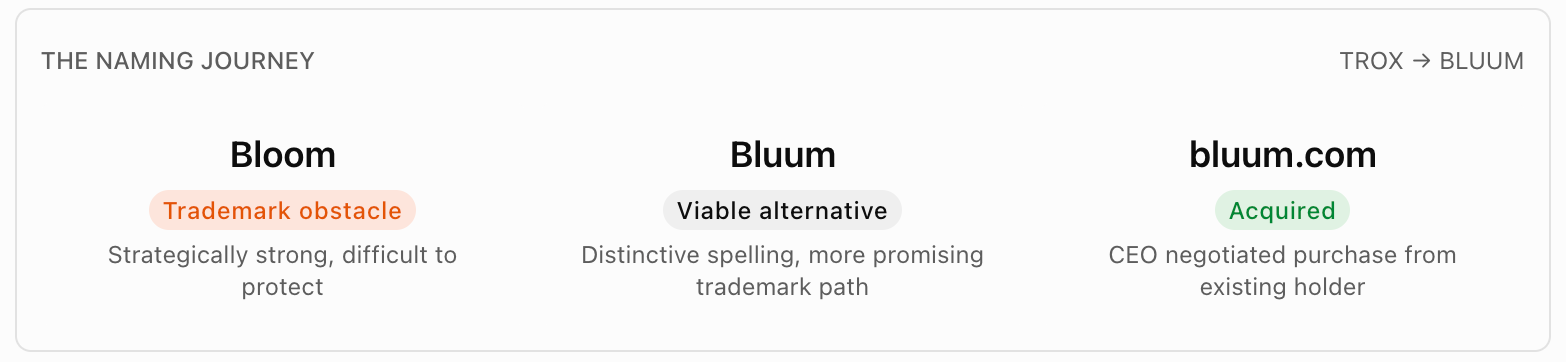
There was just one problem with Bloom: trademarking it was going to be extremely difficult.
The word was already widely used, including in potentially conflicting trademark territory. Our initial evaluation reflected that reality with a gettability score of zero.
We explored an alternative spelling: Bluum. It preserved the meaning and familiar pronunciation while offering a more promising path toward trademark protection.
But bluum.com was already owned by another company.
For many businesses, that might have ended the conversation. Not this one.
The stoic CEO was spellbound by the possibilities of Bluum. He believed enough in the strategic concept to pursue the purchase of the company and the domain. And just like that, our client had successfully acquired bluum.com.
It's a fascinating reminder that naming constraints aren't always absolute. Sometimes they're financial.
An early-stage startup may need to prioritize names with readily available domains and fewer acquisition obstacles. An established company with greater resources can sometimes pursue a name that requires negotiation and investment.
Of course, money can't magically erase a conflicting trademark, and purchasing a domain doesn't establish trademark rights. Those are separate matters requiring appropriate legal diligence.
But the Bluum experience demonstrates something important: the right name isn't always the easiest one to get. Sometimes it's the one worth going after.
The name is only the beginning
Trox didn't become Bluum simply because we discovered a better collection of letters.
The company needed an identity that could unite its people, distinguish it from competitors, and express something meaningful about its ambition to improve education.
The naming process helped establish that foundation. The resulting name gave us a rich territory for developing the visual identity, messaging, and brand experience that followed.
And because employees had participated in the journey, the new identity wasn't entirely foreign to the people who would ultimately represent it.
That connection matters. At Attic Salt, we believe brands become powerful when the people behind them understand, believe in, and embody what they stand for. A new name can introduce that shared meaning, but only the organization can bring it to life.
Today, our naming methodology combines strategic expertise, organizational participation, and AI-assisted exploration. We investigate broadly, evaluate rigorously, and help clients navigate the practical realities of bringing a name into the world.
Every engagement is different. Not every company needs a naming sprint, and not every business needs a new name in the first place. The process should serve the challenge, not the other way around.
Ultimately, we're not trying to find the cleverest combination of letters.
We're trying to find a name an organization can believe in, build upon, and make its own.


